Jena's comments:
"If you can create it, then you have the right to protect it and legally claim it as your own." This is the legal definition of copyright. So, what does it mean? Well, any copyrightable materials are works such as audio, books, artwork, plays, movies and videos. Only the owner has the right to use and reuse his/her work without permission. I was surprised to learn that dance can also be copyrighted along with movies, film, and music. Are Michael Jackson's moves copyrighted? What about MC Hammer? I can think of a few others, but I'm sure you get my point. A copyright for a company lasts for 100 years and a lifetime plus 70 years for an individual owner. That is quite a long time. It seems that copyright is all about money and not about creativity. In Brazil, artists are more interested in becoming popular by allowing their music to be mixed and played at large parties and clubs. If the audience likes the music, the artist will be able to perform in a concert where he/she can make some big money. In the US, pirating and mixing music is a crime. What does that say about our country?
As an educator, we are not covered by the tag, "All images, clips, and audio captured are intended for educational use only." As stated in the videos I watched, if I can remove the copyrighted material and still teach the lesson, then that usage doesn't fall under the Fair Use umbrella. I would have to obtain permission from the original author or owner. With fair use, I can borrow a small amount of copyrighted work for teaching, news reporting, parody (comedy), and critical comment (Walter Cronkite type of stuff). Fair use is only a legal defensible position, not a right. I have to follow certain rules as with everything else. In short, how I use it and how much I use. It is very important to remember to always give credit to the original creator. Creative Commons (creativecommons.org) is a great place to look for this type of material. On this site, you can find all types of works that you are free to use as long as you site the source and give credit. Symbols of the creative commons license inform users how they are allowed to use the work. The owners are giving us permission to use their work in different creative ways instead of stifling our creativity. I really like the TED talk by Larry Lessig. What caught my attention the most was what he said about John Philip Sousa. What great foresight Sousa had about where our culture was headed, from a Read/Write society to a Read/Only society. This is so true in many areas. The kids of today are trying to tell us that they want to be allowed to have the right to be creative in any way they choose, but it is our job to teach them the correct and legal way in which to express their creativity. I feel confident that now I am able to do just that.
Here's my response to Jena:
Jena, That's great that you have come to this understanding. I, also, have had some issues clarified. However, I still need some some more clarification. I will bookmark the creativecommons.org website. I think that there is a general umbrella that the rules can be applied to, but like any legal document, it is changing and in flux. It would be wise to work on a case-by-case basis. This summer, I plan to work up a case study in which my students could apply and defend their positions on use of a particular type of creation, whether it be musical, image-based or dance based. This should provide an avenue for critical thinking and defending their opinions.
Sunday, July 1, 2012

Leadership Post II
1. After some reflection this weekend regarding the research I have been conducting at Salish Kootenai College, I've decided that developing a professional presentation is going to be my best choice. I chose this for three reasons. The first would be that the college I teach at has started a new program where, each Friday, instructors have been presenting to the other faculty, some of the dynamics of research they have been conducting. I have not been asked to present yet, but would like to be prepared if asked.
2. The second reason is that I believe the faculty could benefit from some of my research findings on retention strategies. I feel hopeful that I could contribute to proactively taking steps to improve our recruitment, retention and ultimately graduation amongst our college. The third reason is that, as a media designer, I am interested in the visual aspect combined with the written findings. I am excited to employ the strategies of both presenting visually and verbally. All of our coursework has been preparing us for this very thing.
2. The second reason is that I believe the faculty could benefit from some of my research findings on retention strategies. I feel hopeful that I could contribute to proactively taking steps to improve our recruitment, retention and ultimately graduation amongst our college. The third reason is that, as a media designer, I am interested in the visual aspect combined with the written findings. I am excited to employ the strategies of both presenting visually and verbally. All of our coursework has been preparing us for this very thing.
I believe I am ready to present.
Week 1/Blog 1 - Response to Julie Hutchinson's Blog

Julia's Blog post:
As a graphic designer & instructor, there is probably no other word (aside from Comic Sans) that evokes fear, uncertainty, and debate like ‘copyright’. The discussion is never over the clear ‘black and white’ issues. For example, clearly you cannot use the Walt Disney signature typeface for a brand name, regardless of whether it’s for personal or commercial use. It’s always over the gray areas. So for this course to start off by delving right into the realm of Copyright and Fair Use is rather commendable, and speaks to the importance of the topic.I think back to the Month 1 Media Literacy & Research course when we had to create a lesson in Second Life. Our team decided to create a lesson centered on the 1776 signing of the Declaration of Independence. We wanted to incorporate the famous 1795 John Trumball painting, and audio of Benjamin Franklin, John Adams, and Thomas Jefferson as depicted in a film about the historic event. It was then that I really learned about the Fair Use Act and how it ‘liberated’ educators from the censorship tyranny that can be inflicted by copyright. Our situation was a prime example of the need to use copyrighted material for the purpose of teaching, AND, without the material, the lesson could not be as effective. Where needed, we obtained the proper usage rights for much of our media. In most cases, all that was required was a citation of the source in the credits.All in all, I look forward to continue learning about the nuances of Copyright and Fair Use, and how it applies to educators and the classroom.

Friday, June 29, 2012
Month 11, Week 1: Copyright Issues
The information presented on Fair Use clarified several things for me. I believe, up until now, I was following loosely the rules established. I have always asked permission before using music in my classroom, for teaching purposes, and I have clarified somewhat the issues for my students. Listening and observing the video has more clearly defined what I am able to use. I'm excited to share these clarifications with my students.
Other issues about remix have always had me wondering how they can do that. Many folks believe that new content is not being created. How can we be 'inspired' by past creation? The fair use right is rooted in the first amendment. The attorney clarified that we must 'use or lose it". I love that it follows reason and logic and is not 'black and white'. We must ask ourselves "What is normal, particularly in the field?" I hope to have the students write about fair use, perhaps use a case study that is complicated in order that they may understand how complicated the issues are.
A rule of thumb is to always credit your sources.
Other issues about remix have always had me wondering how they can do that. Many folks believe that new content is not being created. How can we be 'inspired' by past creation? The fair use right is rooted in the first amendment. The attorney clarified that we must 'use or lose it". I love that it follows reason and logic and is not 'black and white'. We must ask ourselves "What is normal, particularly in the field?" I hope to have the students write about fair use, perhaps use a case study that is complicated in order that they may understand how complicated the issues are.
A rule of thumb is to always credit your sources.
Leadership Post 1: Publish or Present

PRESENT:Conferences that I have attended include, but are not limited to: Association of American Colleges and Universities (AACU).
National Science Foundation Science Engineering Technology and Mathematics (STEM), National Girls Collaborative on STEM.
 National Center for Women and Technology (NWIT - LINK).
TCUP Cultural and Curriculum sponsored by Quality Education for Minorities (QEM) in conjunction with NASA and the Lilly West conference of the International Alliance of Teacher Scholars Evidence-based teaching and learning. Here's the link to the Lilly conference.


While attending these conferences, I saw many opportunities to present my experiences of working at a tribal college. The most recent conference that I attended at Evergreen State College in Washington would have been the perfect opportunity to share my research.
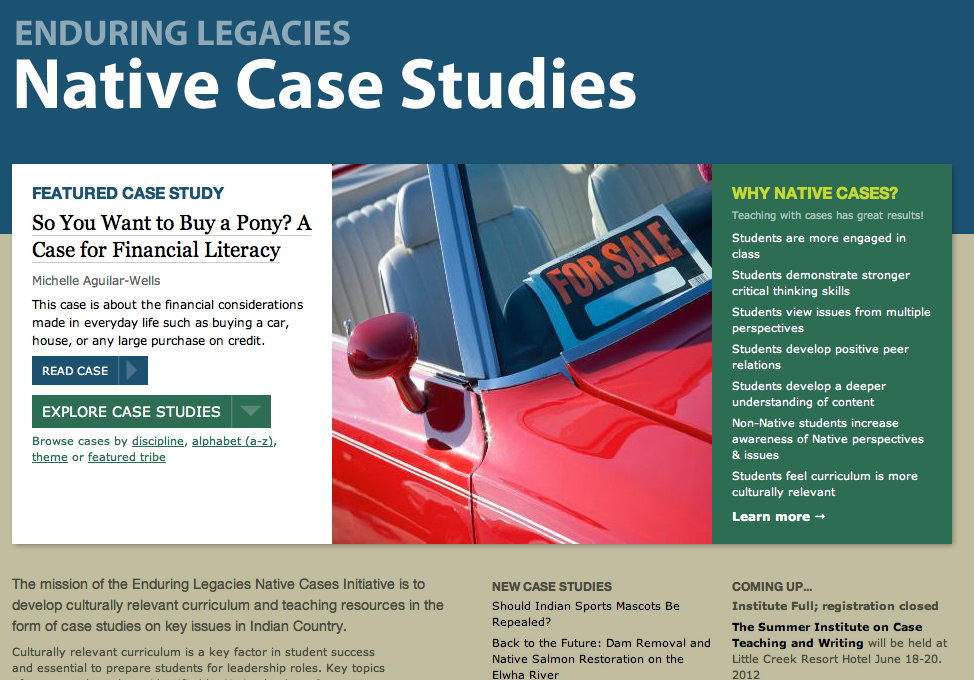
Here's the link to the Native Case studies: Enduring Legacies.
At two of these conferences, I did present. When looking at the research I have conducted, I look forward to fine tuning the presentation and writing in order to present.
PUBLISH: Another option for my research is to publish. There are several publications that I am considering. The first and foremost is the Tribal College Journal of American Indian Higher Education. Here's the link to the Tribal College Journal.

This journal provides voice and vision to the ongoing efforts of primarily the tribal colleges of the United States. I believe my research may contribute to efforts and provide unique insight to that of other tribal college professor and instructors. Here's a link to an article I previously published in the Tribal College Journal.
At two of these conferences, I did present. When looking at the research I have conducted, I look forward to fine tuning the presentation and writing in order to present.
PUBLISH: Another option for my research is to publish. There are several publications that I am considering. The first and foremost is the Tribal College Journal of American Indian Higher Education. Here's the link to the Tribal College Journal.

This journal provides voice and vision to the ongoing efforts of primarily the tribal colleges of the United States. I believe my research may contribute to efforts and provide unique insight to that of other tribal college professor and instructors. Here's a link to an article I previously published in the Tribal College Journal.
Wednesday, June 27, 2012

Month 11: WIMBA Archive
After watching the archive, I learned several things. The first thing I learned is new media venacular, as I am always interested in learning the vocabulary associated with the field of study. The phrase that Dr. Bustillos used was "over modulated." As it is not yet defined in the urban dictionary, I inferred it to mean that when too many applications are open on your desktop, it effects and drains the effectiveness and performance of the other programs. Is this correct? hmmm.
Furthermore, I appreciate the pacing that was discussed. I like the metaphor of the four-minute mile and this I will relay to my students.
Subscribe to:
Posts (Atom)